What is SWE?
Snow Water Equivalent (SWE) measures how much water is stored in the snowpack — specifically, the depth of liquid water you'd have if you melted the entire snowpack in place. It's the single most important number for understanding how much water mountain snowpack holds, and it's the metric water managers, hydrologists, and increasingly backcountry skiers rely on most.
According to the USDA Climate Hubs Northwest, between 60 and 70% of water supplies in the West come from snowmelt — with high mountain regions on the upper end of that range. Knowing how much water is locked in the snowpack on any given day is essential for planning everything from irrigation scheduling to spring river levels.
One inch of rain can produce anywhere from two inches of sleet to over 50 inches of very dry, powdery snow depending on air temperature. Because different storms create snow with wildly different densities, depth alone doesn't tell you how much water is actually there. SWE does.
How SWE is Measured
The NRCS has been measuring SWE manually since the early 1900s through a network of Snow Courses — permanent transects where surveyors take physical samples using a hollow metal tube and a scale. Starting in the late 1970s, automated SNOTEL sites took over the bulk of this work using snow pillows: fluid-filled bladders buried in the ground that measure the weight of snow pressing down on them, converting that weight to a SWE reading transmitted hourly via satellite.
There are now over 850 active SNOTEL sites across 12 western states, alongside roughly 400 manual snow courses still measured each winter — providing a long historical record that stretches back decades at many locations.
SWE vs. Snow Depth: When Each Matters
| Situation | Better Metric | Why |
|---|---|---|
| Estimating total water in snowpack | SWE | Directly measures water content regardless of density |
| Estimating new snowfall during a storm | SWE change | Depth sensors go blank in active snow or wind; SWE stays reliable |
| Checking coverage for skiing | Snow Depth | More intuitive for assessing if there's enough snow to ski on |
| Comparing this season to historical average | SWE % of median | Normalizes across different density years |
Comparing SWE to the 30-Year Average
The current standard reference period is 1991–2020, which the NRCS uses as the baseline for calculating what's "normal" at each SNOTEL station. Comparing today's SWE to that median gives you percent-of-normal — a quick way to gauge whether a season is running above or below average.
As the USDA Climate Hubs note, this baseline has shifted over time as snowpack has declined across much of the West. The 1991–2020 median is already lower than the previous 1981–2010 median at many sites, meaning something that reads as 100% of current normal may still be below the historic long-term average. Context matters when interpreting these numbers.
Viewing Historical SWE on the OutsideDB Dashboard
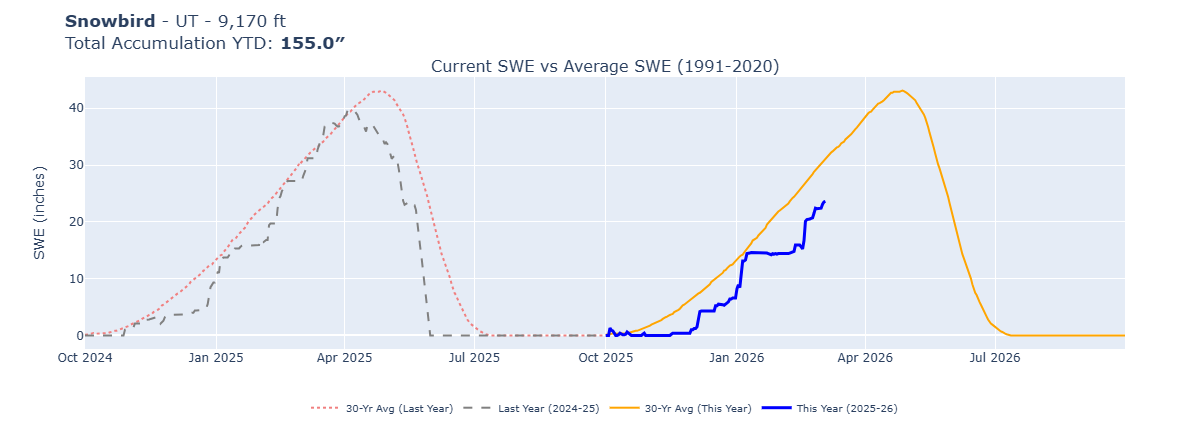
The OutsideDB Historic page plots current-season SWE alongside the 1991–2020 median for any SNOTEL station, letting you see at a glance how this year's snowpack is tracking against the 30-year average. The chart also overlays the prior water year for direct season-to-season comparison.
Why SWE is Shifting
Snowpack has been decreasing across much of Idaho, Oregon, Washington, and parts of Alaska. SNOTEL's long automated record — stretching back to the late 1970s — has allowed scientists to detect changes that manual surveys would have missed, including a shift in the timing of peak snowpack. Historically April 1 was considered the reliable peak date; at many sites that peak is now arriving 1–3 weeks earlier.
For backcountry skiers, this trend translates directly: earlier melt, shorter stable windows, and more year-to-year variability in how much snow is actually available. Checking SWE relative to the historical median is one of the most useful habits you can build into your pre-trip research.
SWE background and climate trend data sourced from the USDA Northwest Climate Hub: Snow Water Equivalent — Its Importance in the Northwest